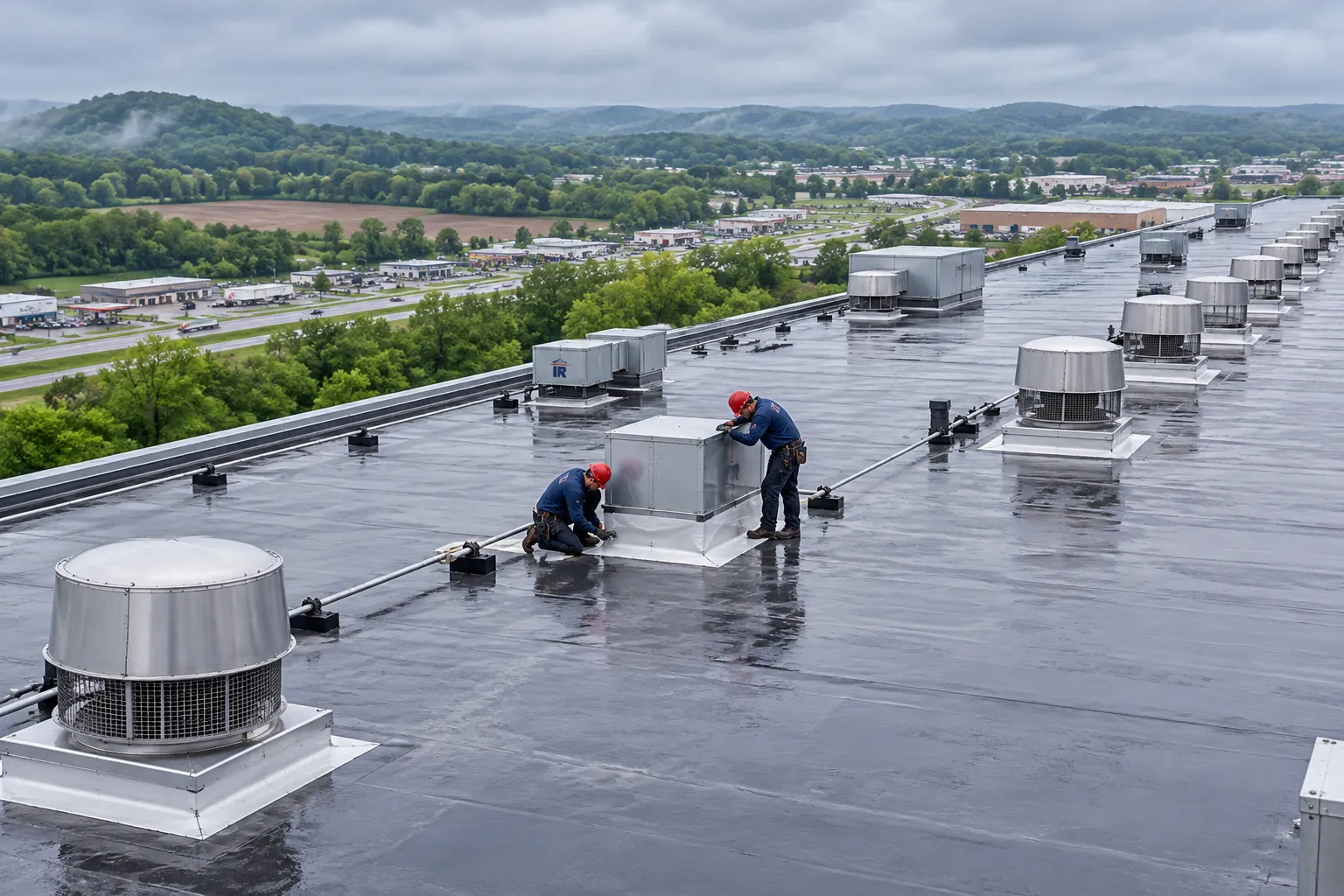
Roofers working across a large industrial roof near Radcliff, KY

Hardin County, Kentucky

Radcliff Commercial Roofing Contractor

New Roofs for Warehouses, Plants, Churches, and Shops

As a Radcliff commercial roofing contractor, we install, replace, and repair TPO, EPDM, flat, and metal roofs on commercial buildings across Hardin County and nearby towns.

First Step
Roof Walk and Core Cuts
Roof Systems
TPO, EPDM, PVC, Metal
Buildings
Plants, Warehouses, Churches, Shops
Counties
Hardin, Meade, Breckinridge, Bullitt

Roof Problems We Find Around Radcliff

Most calls to a Radcliff commercial roofing contractor start with one of these six conditions, grouped here by what drives them.

Rain

Ponding Between Drains

You See
Water still standing on the membrane two days after a storm, ringed with dirt.
What It Means
Low spots between bays or a sagging steel deck hold water against seams. Tapered insulation and crickets move it to the drains.
Freeze

Opened End Laps on Metal

You See
Sealant cracked along panel end laps and ice packed into gutters and scuppers.
What It Means
Freeze-thaw swings work the laps loose. They get opened, cleaned, and reset with fresh butyl tape before water reaches the purlins.
Hail

Fractured Membrane Over Soft Insulation

You See
Dented panels or small star cracks in single-ply after a hail storm.
What It Means
Hail breaks membrane where the insulation under it is soft. A cover board under the new sheet gives it a hard base.
Sun

Aging Sealant at Curbs

You See
Sealant shrinking away from rooftop unit curbs, pipe boots, and pitch pans.
What It Means
Summer heat ages sealant fastest at penetrations. Pre-molded boots and welded curb flashing outlast a bead of caulk.
Foot Traffic

Punctures on Service Routes

You See
Scuffs, screw holes, and small tears between the roof hatch and the HVAC units.
What It Means
Service crews, dropped screws, and ladder feet puncture single-ply. Walkway pads along those routes take the wear instead.
Age

Patches Stacked on Patches

You See
Several rounds of patches at the same seams, drains, and ceiling-stain spots.
What It Means
When core cuts show wet insulation across large sections, repairs stop holding and the choice becomes recover or tear-off.

Commercial Roofing Systems We Install in Radcliff

Each row shows the roof a service fits, how the system is fastened or sealed, and the upkeep that keeps it dry.

ServiceBest RoofSeams Or AttachmentTypical BuildingUpkeep Path
Commercial Roof RepairAny system with local leaks at drains, curbs, or seamsMatched to the existing roof: welded, taped, or screwedOccupied buildings with one or two leak spotsSpring and fall walks catch the next leak early
TPO RoofingFlat and low-slope roofs with open field areaHot-air welded seams, probed along their full lengthWarehouses, retail strips, offices, schoolsSeam and flashing checks; clear walkway routes
EPDM RoofingFlat roofs with wide runs and fewer penetrationsPrimer and seam tape, lap sealant at T-jointsOlder flat roofs, churches, cold-storage buildingsTape edges and flashing checked as the rubber ages
Flat RoofingRoofs with parapets, interior drains, and ponding historyTapered insulation, cover board, single-ply membraneRetail strips, restaurants, offices with parapetsDrains and scuppers kept clear; new ponding watched
Industrial RoofingPlant roofs with heavy equipment, stacks, and ventsMembrane matched to exhaust; curbs raised for full flashingFactories, plants, distribution centersWalkway pads to every fan; grease boxes emptied
Metal RoofingPitched roofs that shed water past their lapsStanding seam on clips, or R-panel with gasketed screwsMetal shops, barns, churches, warehousesFastener and washer checks; end laps reset

Each system is laid out in more detail in commercial roofing services for Radcliff buildings.

How a Radcliff Commercial Roofing Contractor Runs the Job

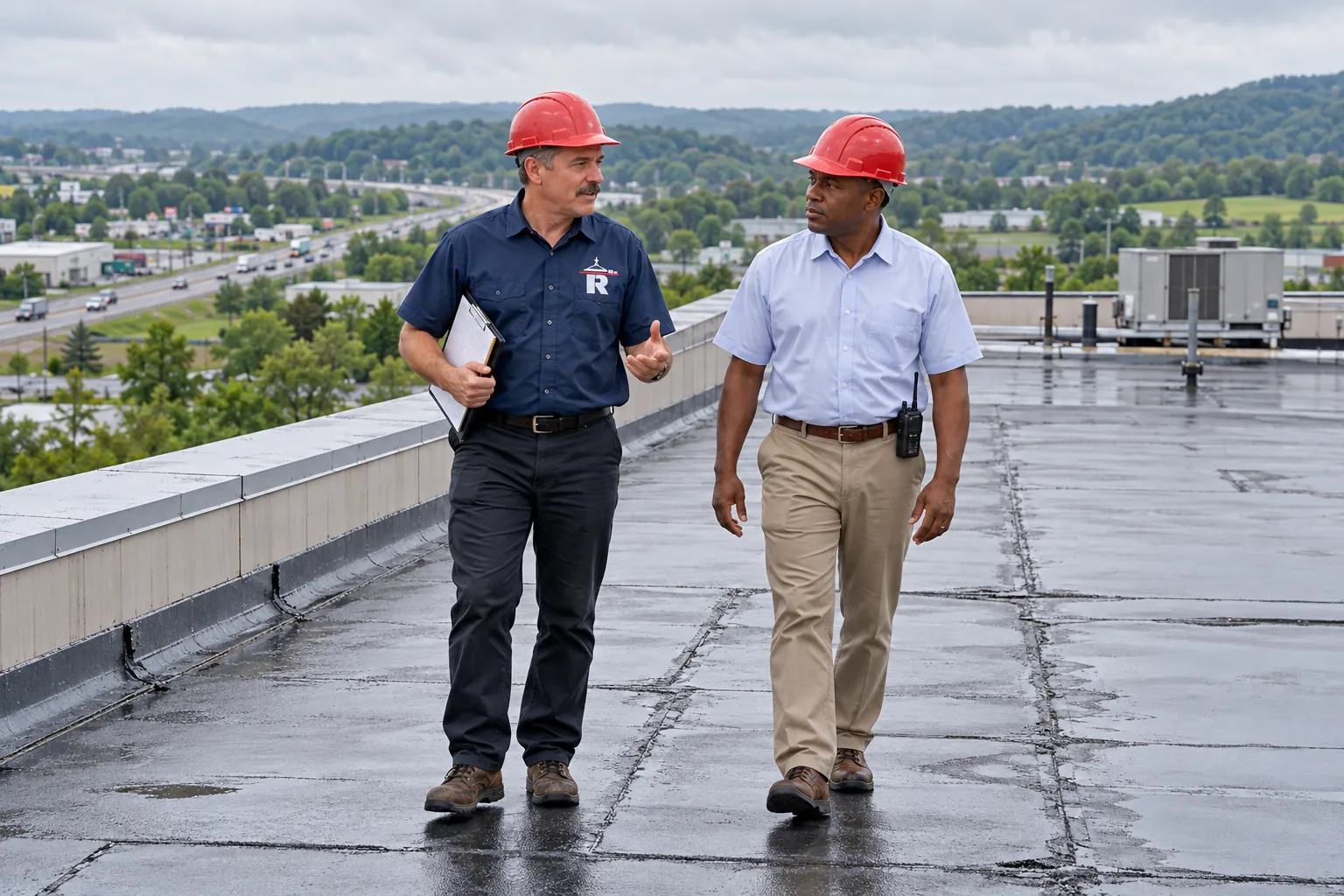
Every roof follows the same order, starting with a walk across the whole surface and core cuts where moisture readings run high.

  1. Roofer walking a commercial roof to inspect seams, drains, and flashing

    Inspect Your Roof

    Crews walk from the edge metal to every drain, curb, and seam, then cut cores where readings run high to learn whether the insulation is wet.

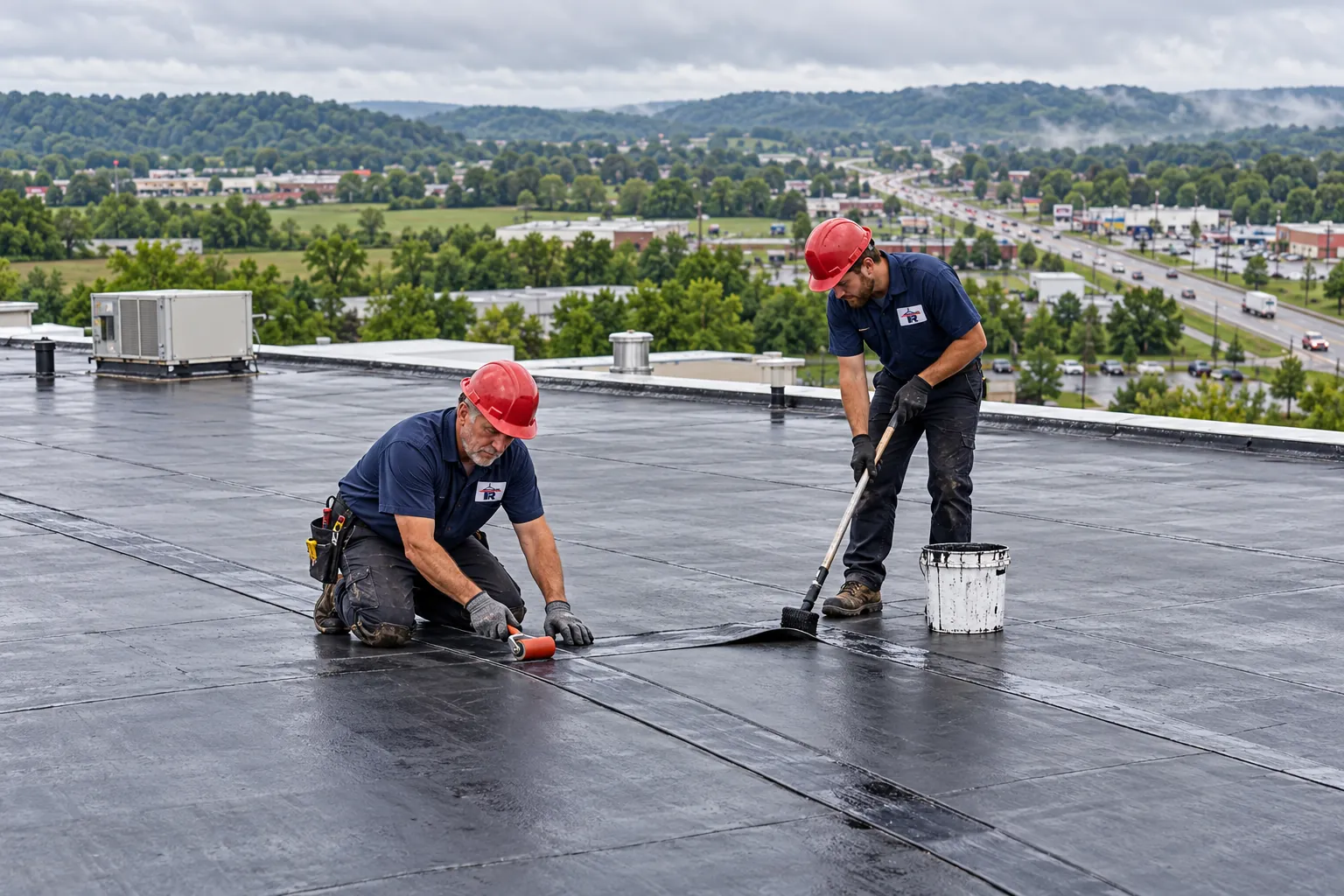
  2. Crew working on a black EPDM rubber roof on a commercial building

    Choose the System

    Deck type, slope, rooftop equipment, and whatever vents onto the roof decide between TPO, EPDM, PVC, or metal panels and how each holds to the deck.

  3. Confirm Permits

    Permits come from the city or county inspector covering the parcel, and rooftop unit disconnects bring in the HVAC side before any deck opens.

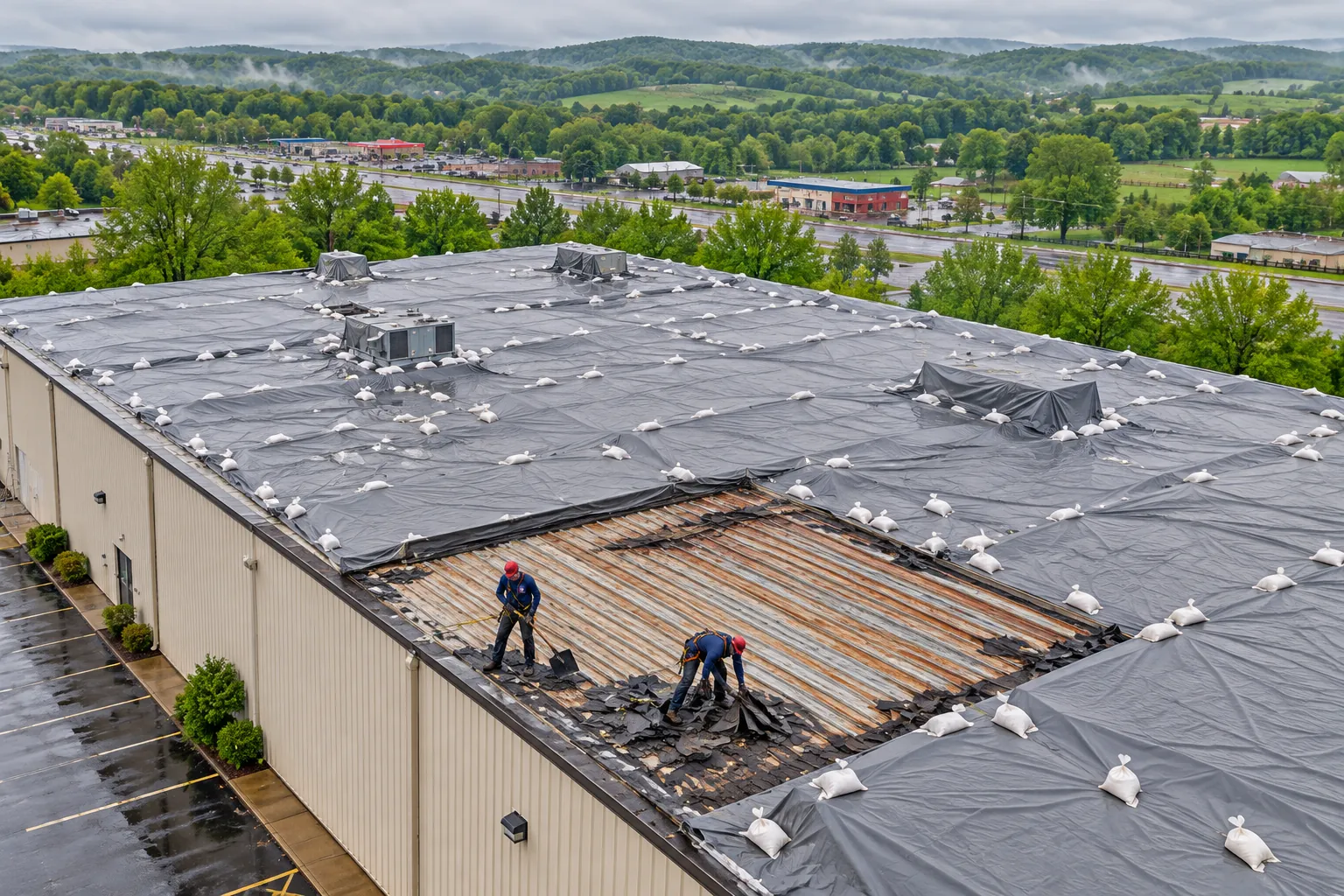
  4. Crew tearing off an old commercial roof down to the deck

    Tear Off in Daily Sections

    Old roofing comes off only as far as the crew can dry in that day, with a sealed tie-in at the edge of the new roof each evening.

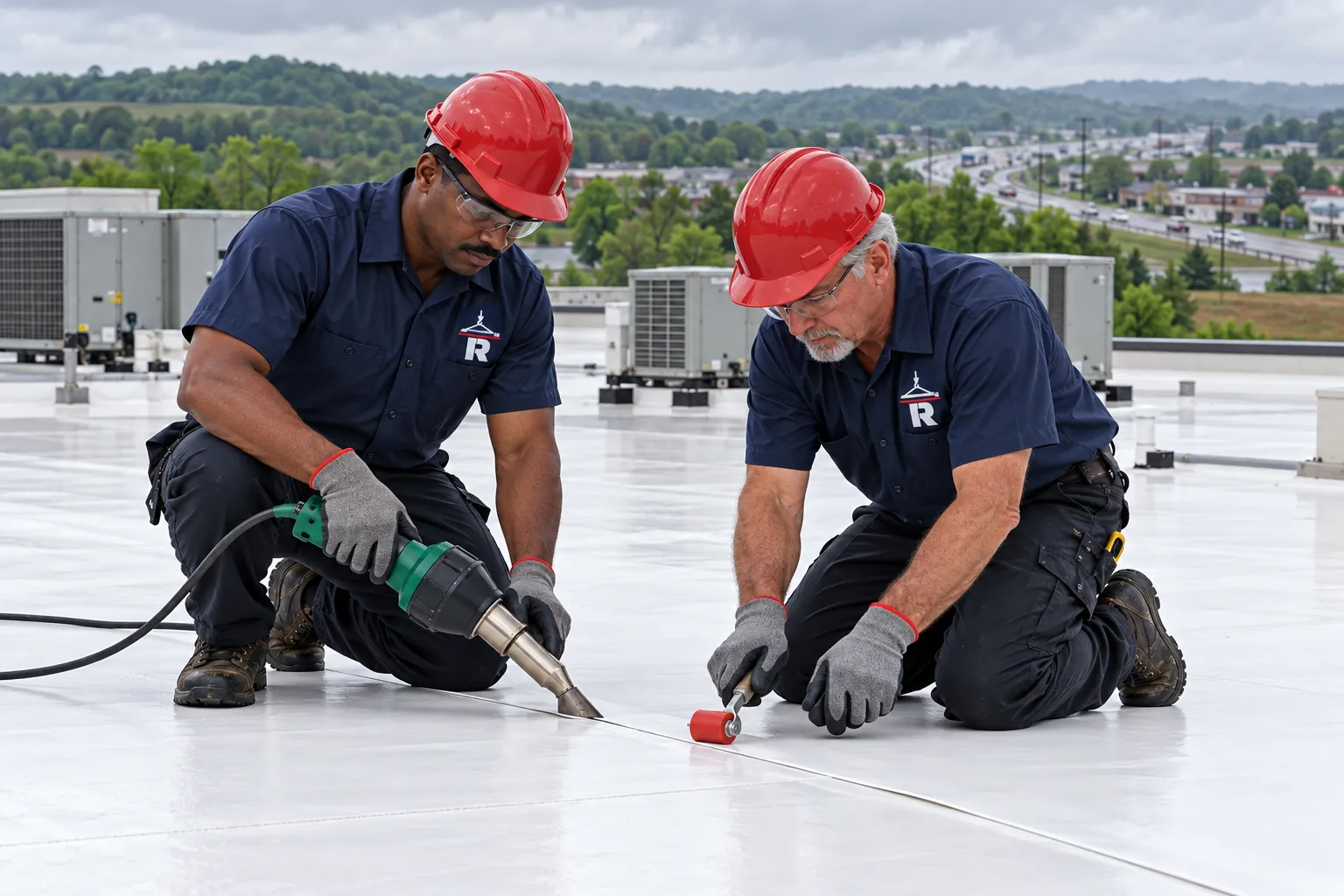
  5. Roofing crew installing white TPO membrane on a commercial flat roof

    Install and Walk It With You

    Insulation, cover board, membrane or panels, flashing, and edge metal go on. Then we walk the finished roof with you and check seams and drains.

Water Coming Through the Ceiling Tile?

Call us with the spot where water shows inside, and we will trace it on the roof above before anything gets cut open.

  • Roof Walk First
  • Leak Traced to Its Source
  • Repair or Replace Explained

Repair, Recover, or Tear Off the Roof

Most owners weigh three paths. Core cuts and a moisture scan show which one the roof can take.

Repair

Roof Condition
Local leaks at a drain, curb, or seam with dry insulation
Insulation
Left in place
Deck Check
At the repair area
Edge Height
Unchanged
Debris and Noise
Least

Recover

Roof Condition
One existing roof, dry insulation, a deck that holds fasteners
Insulation
Kept where dry; wet boards cut out and replaced
Deck Check
Only at core cuts
Edge Height
Edge metal and scuppers raised
Debris and Noise
Less
What We Install

Tear-Off and New Roof

Roof Condition
Wet insulation across large areas, two roofs, or rusted deck
Insulation
Removed and replaced, with tapered insulation to drains
Deck Check
Full view of the deck
Edge Height
Stays close to the current height
Debris and Noise
Most

Top Commercial Roofing Results for Radcliff Buildings

Owners describe the left column before a new roof. The right column is the same building once the roof is finished.

Before The New Roof

  • Water sitting between drains after every storm
  • Patched seams that reopen each spring
  • Short curbs with caulk where flashing should be
  • Soft insulation underfoot near the hatch
  • Stained ceiling tiles in the same three rooms

After The New Roof

  • Tapered insulation carrying water to each drain and scupper
  • Welded or taped seams probed along their full length
  • Curbs raised so flashing runs up the face and under the unit
  • Dry insulation and a cover board under the membrane
  • A finished roof walked with you, seam by seam

Nearby Towns We Work In

Is your building near Radcliff? We install and replace commercial roofs in the towns below; for anywhere else, call us or send us a message.

TownCountyWhat We See On Roofs There
Radcliff Home BaseHardinReroof permits start with the City of Radcliff, which points commercial work to the shared Hardin County inspector.
Vine GroveHardinRoof drains tied into storm piping add a plumbing review, while open eave gutters stay with the roofing scope.
BrandenburgMeadeRiver fog keeps decks damp into the morning, so adhered seams wait until the surface is dry.
MuldraughMeadeA Meade County city beside the Hardin line, where crane and dumpster spots on streets go through city hall.
IrvingtonBreckinridgeRooftop unit resets bring electrical review through the county or city office alongside the roof permit.
HardinsburgBreckinridgeService drops land at the eave on metal shops and farm buildings, right where new trim and gutters go.
Lebanon JunctionBullittMetal shops and warehouses here answer to the Bullitt County inspector, a different office from Radcliff.
EkronMeadeThe KZZ64 weather radio transmitter sits here, and its alerts set how much deck a crew opens in a day.
West PointHardinPermit questions start at West Point city hall before anything goes to Hardin County.
RineyvilleHardinRoof permits go straight to the Hardin County local building inspector.
PaynevilleMeadeThe Meade County inspector reviews the scope, so tear-off depth and edge metal changes go in the first call.
GustonMeadeAnother Meade County address, where the county office also covers new drains and scupper changes.
McDanielsBreckinridgeThe Breckinridge County inspector takes roof permits, the same office that covers Hardinsburg and Irvington.

Radcliff Building Owners Ask About Their Roofs

Short answers on new roofs, local weather, inspection prep, and taxes. Longer ones are in the commercial roofing FAQ.

New Roofs

What does a commercial roofing contractor install on business buildings?

Everything from the deck up. A flat or low-slope roof gets insulation and tapered insulation to the drains, a cover board, a single-ply membrane, flashing at each curb and parapet, and edge metal.

A sloped metal building gets panels, trim, closures, and gutters. Leaks start most often where two of those pieces meet, so the joints get the closest look.

What does commercial roofing for warehouses in Radcliff involve?

Warehouse roofs are wide and often sit on steel decks, which suits mechanically attached TPO with fastener rows set tighter along the perimeter where wind pulls hardest.

Long bays tend to pond between interior drains, so tapered insulation and crickets get planned in. Walkway pads run to the rooftop units, and racked product under open deck gets tarped during tear-off.

Weather

How does Radcliff weather wear on a commercial roof?

Each kind of weather hits a different part of the roof. National Weather Service normals for Louisville average about 48.3 inches of precipitation a year, including 13.4 inches of snow.

Rain shows up as ponding at drains, freeze-thaw opens end laps and ices scuppers, hail fractures membrane over soft insulation, and summer heat ages sealant at curbs. A cover board and tapered insulation answer most of it.

Before The Walk

What should I have ready before a commercial roof inspection?

Bring the roof size, how the building is used, and the roof age if you know it. Leak dates and photos of ceiling stains help trace water faster, and drawings or earlier core cut results save repeat work.

Open the hatch, ladder, or interior access, and list the rooftop units, exhaust fans, and skylights so the walk covers all of them.

Taxes

Can a new commercial roof qualify for the Section 179 deduction?

It can. IRS Publication 946 lists roofs among the qualifying improvements to nonresidential real property, so a new roof on an existing commercial building fits the rule.

For tax years beginning in 2026, the maximum deduction is $2,560,000, and the phase-out starts above $4,090,000 of qualifying property. Ask your CPA how the invoice separates the roof from repairs and replaced rooftop units.

Talk to a Radcliff Commercial Roofing Contractor

Tell us what the roof is doing and what sits on it. We will walk it, cut cores where needed, and lay out repair, recover, or replacement.

Call Us (364) 205-6782